
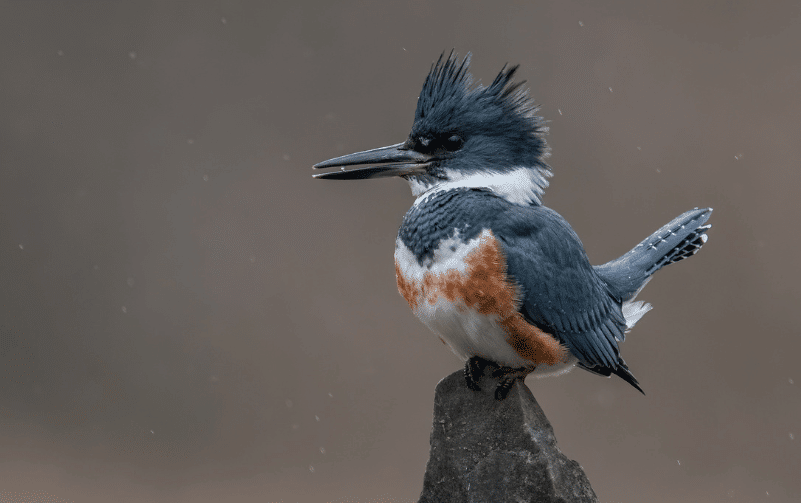
A sharp, rattling call. A flash of blue-gray above the water. Then a bird with a spectacularly untidy crest settles onto a branch and gets back to fishing. Those are good clues that you have found a belted kingfisher.
Here in Northern California, the species is the Belted Kingfisher (Megaceryle alcyon), the name used by the Cornell Lab of Ornithology. Its big head, heavy bill and headfirst dives make it one of the most memorable birds to watch along the Napa River.
There is plenty going on between those dives, too. Courtship can involve a fish delivery. Nest construction means digging into a bank. Even the way the young digest a meal changes as they grow. Here is what to look for on your next paddle.
How to identify a belted kingfisher
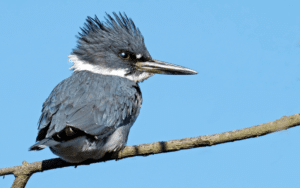
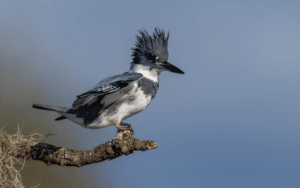
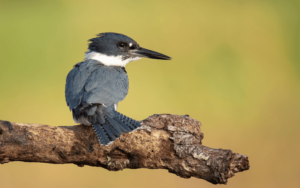
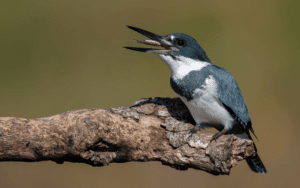
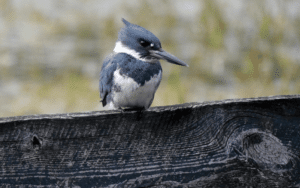
Start with the shape. A belted kingfisher has a stocky body, a large head, a shaggy crest and a long, straight bill. Adults measure roughly 11 to 14 inches from bill to tail. Look for blue-gray upperparts, a white collar and white underparts, rather than the bright turquoise often associated with other kingfishers.
- Adult male: a blue-gray band across the breast.
- Adult female: the same blue-gray breast band, plus a rusty band across the belly and down the sides.
- Young birds: rusty markings can appear in the breast band, so a quick glimpse is not always enough to determine sex.
The female is more colorful than the male, an interesting reversal of the pattern many people expect in birds. If the chest is hidden, enjoy the sighting without forcing an identification beyond the species. Cornell’s identification guide has photographs of males, females and immature birds for comparison.
Listen before you look
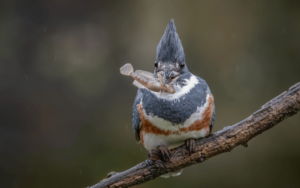
The rattle can give a kingfisher away before you find it. Scan branches, posts and other exposed perches overlooking the water. Then watch the open space above the river, where a bird may fly between fishing spots. Cornell describes these calls and riverside patrols as useful clues for finding the species.
Binoculars help, but patience helps too. Once you have found the perch, give yourself a moment to see what happens next.
The hunt: perch, hover, plunge
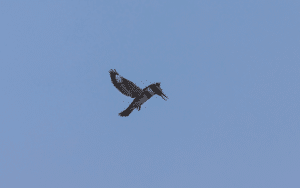
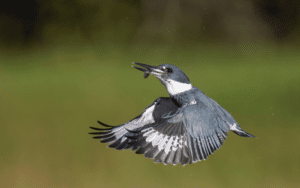
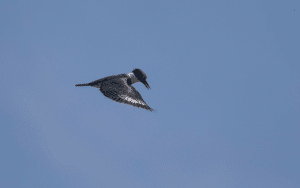
A kingfisher’s fishing spot usually has a view. From a branch, piling or other perch, the bird watches for small fish near the surface. It can also hover over the water before diving. The catch happens headfirst, with the bill doing the grabbing.
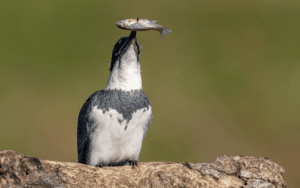
Keep watching after the splash. A successful hunter may return to a perch and strike the fish against it before swallowing the meal headfirst. Fish make up much of the diet, but crayfish and other small animals are on the menu as well. These feeding behaviors are described in the Pennsylvania Game Commission’s species account.
That sequence makes a sighting worth lingering over. The bird sitting still on a branch may be the beginning of the action.
A surprising detail in the dive
The kingfisher spots its prey from above, then dives with its eyes closed. That brief moment is easy to miss from a kayak, but it is part of the feeding sequence documented by the Cornell Lab. Watch the bird before it launches, then follow it back to the perch. There may be a fish in that bill.
Courtship and a nest inside the riverbank
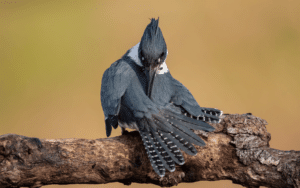
Belted kingfishers spend much of the year on their own. During the breeding season they form pairs, and the male may offer the female a fish during courtship. The pair also defends its territory, chasing other kingfishers away with loud calls. Audubon: courtship and calls.
The nest is a burrow, not a cup of twigs in a tree. Both birds help excavate it; Cornell reports that males generally spend more time digging than females. A typical tunnel reaches about 3 to 6 feet into an earthen bank and slopes upward toward an enlarged chamber. The upward slope helps keep rainwater from collecting inside. Cornell: nest construction.
From a kayak, an exposed bank can look like an unremarkable patch of dirt. For a nesting kingfisher, it can be essential habitat. Leave burrow entrances alone and give birds room to come and go.

Raising young takes two parents
Both parents incubate the eggs and feed the young. Incubation lasts about 22 to 24 days, and the young generally leave the burrow about 27 to 29 days after hatching. Leaving the nest does not mean they immediately stop relying on their parents; feeding continues afterward. Audubon: eggs and young.
There is another detail worth knowing about all those fish dinners. Nestlings can digest bones and scales. Around the time they leave the nest, they begin casting pellets containing indigestible remains. Researchers can examine those pellets to learn what the birds have eaten. Cornell: nestling digestion.
Why the Napa River is worth watching
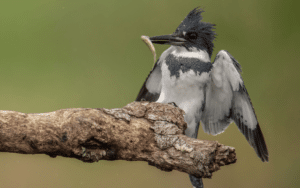
A kingfisher needs more than water. It needs prey it can see, a place to watch from and, during the breeding season, suitable ground for a nest tunnel. The Missouri Department of Conservation’s field guide describes the connection between visible prey, fishing habitat and earthen nesting banks.
That gives you a useful way to read the Napa River as you paddle. Look at the branches above the water, the shape of the bank and the places where a bird could get a clear view below. You are looking for the ingredients of a fishing spot, not simply searching for something blue.
Keep an eye out for the neighbors
The California Department of Fish and Wildlife’s Napa-Sonoma Marshes bird list includes belted kingfishers, great blue herons, great egrets, snowy egrets and osprey, among many others. It documents the wider marsh area, rather than promising particular sightings on a downtown Napa paddle.
There is a lot to notice even when a kingfisher moves out of view. Watch where other birds perch, feed and travel. A few quiet minutes can reveal much more than a quick scan of the shoreline.
When can you see belted kingfishers?
Belted kingfishers use rivers, lakes, estuaries and coastal waters. Across their range, seasonal movements are closely tied to access to open water and food. Some remain where water stays open; others migrate. Audubon: range and migration.
Choose a suitable day to paddle, then listen and watch along the way. Wildlife sightings depend on the birds and the conditions, not the reservation calendar.
How to watch from a kayak without disturbing the bird
The best view is one that lets the kingfisher carry on fishing. Repeated disturbance can cause these birds to leave an area, especially around nesting habitat. Missouri’s field guide notes their sensitivity to frequent human disturbance.
- Look ahead. Scan perches before paddling close to the bank.
- Use binoculars or your camera’s zoom. Get a better view without closing the distance.
- Leave nest banks alone. Do not approach a burrow, land beside it or block a bird’s route to the entrance.
- Give a restless bird more room. If it keeps moving away as you approach, stop following it.
- Keep track of your paddle and route. A bird sighting should not pull your attention away from conditions on the water.
Watch first, photograph second
A kingfisher can be gone while you are still opening the camera. Take a good look first. If you do reach for your phone, keep it secured and avoid leaning out of the kayak for a better angle. A distant photograph and a good memory are enough.
Look for river wildlife on the Napa River History Tour
Our signature Napa River History Tour combines local storytelling with time on the river. Justin Perkins grew up in Napa and started the tour in 2013. It is a way to connect what you see from the kayak with the place around you, from Napa’s history to the wildlife along the banks.
The experience includes guided storytelling and may include time for independent exploration afterward. Your guide will explain the route and return arrangements. Meet at 100 Riverside Drive, Napa, and follow your reservation confirmation for the final details. Kingfishers and other wildlife are possible sightings, never guaranteed.
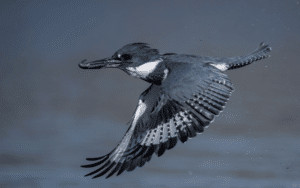
See Napa River History Tour dates and book your paddle.
Prefer to explore independently? Our self-guided rentals include a kayak, paddle, fitted life jacket and briefing.
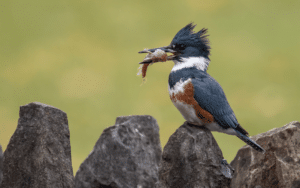
On your next paddle, listen for the rattle. Find the perch. Then give the bird some room and watch the water below it. The next dive could happen quickly.
Sources and further reading
Sources reviewed October 22, 2026. These ornithological and wildlife-agency resources support the species information above; local records describe the broader area rather than guaranteed tour sightings.
- Cornell Lab of Ornithology, All About Birds: Belted Kingfisher overview, identification and life history.
- National Audubon Society: Belted Kingfisher field guide.
- Pennsylvania Game Commission: Belted Kingfisher species account.
- Missouri Department of Conservation: Belted Kingfisher field guide.
- California Department of Fish and Wildlife: Napa-Sonoma Marshes Wildlife Area bird list.