Look for herons, egrets, belted kingfishers, ducks and turtles when you paddle the Napa River. Watch the banks as well as the open water. A bird on a branch or a turtle on a log can give you plenty to look at before anything swims past the kayak. Regional references include Napa County’s stream-wildlife guide and CDFW’s Napa-Sonoma Marshes bird list.
The Napa River History Tour brings these observations into a paddle full of local stories. Napa Kayak founder Justin Perkins grew up in Napa and started the business in 2013. There is history along the banks, and quite a bit going on in the water below them.
Why the wildlife changes along the river
Think of the Napa River as a series of connected habitats. Upstream near Yountville, the Napa River Ecological Reserve protects riverbank woodland dominated by valley oaks. Farther south, the Napa-Sonoma Marshes Wildlife Area contains baylands, tidal sloughs and wetlands. A bird searching a wooded bank and a duck feeding in a marsh pond are using different parts of the same wider landscape.
Beyond the lower river lies San Pablo Bay. Its refuge includes tidal marsh, mudflats and seasonal wetlands, providing feeding and resting habitat for migrating and wintering waterbirds along the Pacific Flyway. That larger setting helps explain the variety of birds in the region. A downtown Napa paddle gives you a closer look at one stretch of river, rather than a tour of all those marshes. U.S. Fish and Wildlife Service: San Pablo Bay habitat.
Napa River wildlife through the seasons
Use the seasons as a way to decide what to pay attention to. They are less useful as a checklist of animals that ought to appear.
| Season | A good thing to watch | What it can tell you |
|---|---|---|
| Spring | Courtship, birds carrying nest material and repeated trips with food | Behavior can reveal the work of raising young. Great blue herons gather sticks for their nests; kingfishers excavate earthen banks. See the heron and kingfisher nesting accounts. |
| Summer | A bird hunting or a turtle settled on a sunny log | Spend time on behavior rather than counting species. The NPS pond turtle profile explains the use of logs, rocks and banks for basking. |
| Fall | The changing mix of waterbirds in the wider estuary | Migration adds another layer to the birds already using the region. San Pablo Bay provides migratory and wintering habitat. |
| Winter | Ducks and other waterbirds in suitable river and wetland habitat | CDFW records canvasbacks and scaup in the Napa River marsh unit’s pond in late December through February. That is a lower-marsh observation, not a downtown sighting forecast. CDFW wildlife guide. |
The stretch of river matters as much as the season. CDFW notes that pond depth and salinity help determine which birds use different parts of the marshes. For a paddler, the useful habit is to notice the setting: open water, an exposed edge, a sheltered bank or a branch over the river. CDFW: wildlife by marsh unit.
Herons and egrets: stay for the next move
A great blue heron can look as though it has been placed at the water’s edge and forgotten. Watch a little longer. The stillness is part of its hunting technique, followed by a quick strike when prey comes within reach. Its specially shaped neck vertebrae help it make that sudden movement. In flight, look for a tucked neck and long legs trailing behind. Cornell Lab of Ornithology: great blue heron.
Great egrets also hunt by wading slowly or waiting in shallow water. Small fish make up much of their diet, but they also take other animals, including crayfish and insects. Watching where a bird places its feet, pauses and turns its head is more interesting than simply ticking off “white bird.” Cornell Lab: great egret feeding behavior.
Belted kingfishers: listen before you look
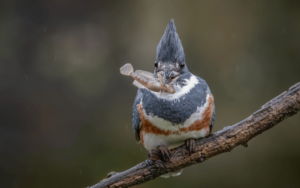
A kingfisher’s rattling call can draw your attention before you find the bird. Look for a large head, a shaggy crest, a heavy bill and blue-gray plumage. Females have a chestnut band below the blue breast band; males lack that extra chestnut band. The photograph near the top of this page shows a perched bird holding a fish, with both bands visible. Cornell Lab: belted kingfisher identification.
There is more to the hunt than the dive. Kingfishers scan from a perch or hover over the water, then plunge for prey near the surface. A successful bird may return to its perch, beat the prey against it and swallow the fish headfirst. If you have just watched one disappear into the water, keep looking at the perch as well. Cornell Lab: kingfisher feeding.
Their nests are burrows excavated in earthen banks, with both members of the pair helping to dig. That makes a bare bank more interesting than it first appears. Watch from the normal paddling route rather than approaching a hole to investigate. Cornell Lab: kingfisher nesting.
Beavers and river otters: look for more than a head
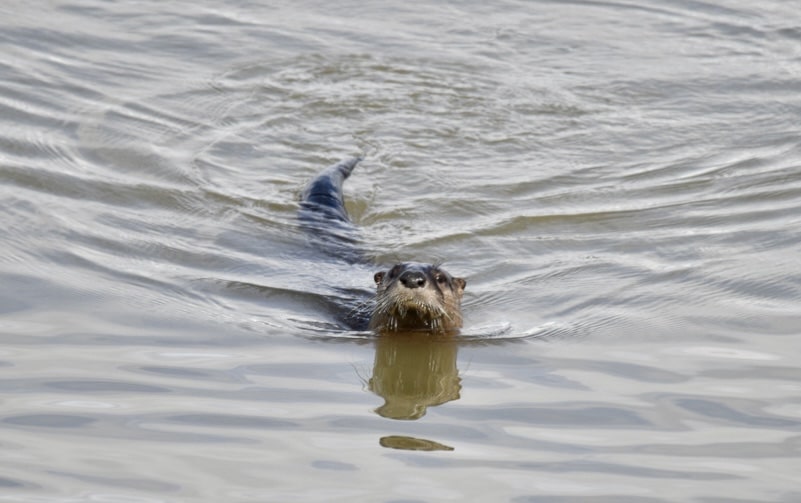
A beaver’s broad, flat tail and stocky body contrast with an otter’s elongated body and tapering tail. Their meals are different, too: beavers eat plants, while river otters hunt animal prey such as fish and crayfish. A clear view of the tail or food can help more than a fleeting glimpse of wet fur. CDFW: beaver biology; NPS: river otter.
Both mammals have been recorded in the Ringstrom Bay unit of the Napa-Sonoma Marshes. That regional evidence gives context without telling us when either animal will appear on a particular outing. CDFW: Napa-Sonoma Marshes wildlife.
A comparison with marine mammals
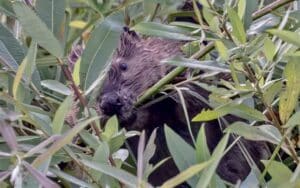
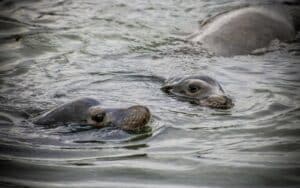
A rounded head at the surface deserves a second look before you name it. Harbor seals, for example, have small ear openings without external ear flaps; sea lions have visible ear flaps. The National Park Service’s harbor seal guide explains the distinction. Compare the rounded heads and whiskered faces in the photograph below.
Turtles and the life beneath the surface
Take a second look at a log before deciding that all its bumps are wood. Pond turtles use logs, rocks and exposed banks as basking places, and may slip into the water when disturbed. Females lay their eggs in nests on land along stream or pond margins, so the bank is part of their habitat, too. NPS: pond turtle habitat and behavior.
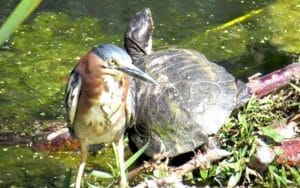
Much of the river’s life is harder to see from above. Napa County’s habitat guide lists fish including steelhead, striped bass and green sturgeon in the river, along with insects such as dragonflies around local waterways. You do not need to identify every fish to notice the connections: the perch a kingfisher uses, the shallows an egret searches and the insects moving above the water all give you something to follow. Napa County WICC: open-water wildlife.
Let the animals carry on
Use binoculars or a zoom lens, keep your voices low and give wildlife room to feed, rest and move. Do not feed or follow animals, and stay clear of nests and dens. If getting a better photograph would mean crowding an animal or leaving your agreed route, enjoy the view you have. You can compare photographs with the sources below when you are back on shore.
Take the History Tour, or explore independently
Choose the Napa River History Tour for guided storytelling and a chance to connect the wildlife you notice with the river around you. The experience may also include independent exploration. History Tour guests meet at 100 Riverside Dr., Napa.

For a self-guided outing, kayak rentals include the kayak, paddle, life jacket and a briefing, also from 100 Riverside Dr. If evening light is your priority, the guided Sunset Kayak Tour is another option; use its reservation confirmation for the meeting place and time.

For help choosing a trip, call or text 707-227-7364. You can also read our season, tide and wind guide and what to expect on a Napa kayak outing before booking.
Sources and further reading
- Napa County Watershed Information & Conservation Council: open-water habitats and wildlife.
- California Department of Fish and Wildlife: Napa River Ecological Reserve, Napa-Sonoma Marshes Wildlife Area, wildlife by unit and bird list.
- U.S. Fish and Wildlife Service: San Pablo Bay National Wildlife Refuge.
- Cornell Lab of Ornithology: great blue heron, great egret and belted kingfisher.
- California Department of Fish and Wildlife: beaver biology. National Park Service: river otter, pond turtle and harbor seal natural history.